
Hello, wonderful friends! As I previously shared, I am embarking on an exciting seven-week journey into the world of minimalism, and I’m thrilled to bring you along every step of the way, starting today with my kitchen. For many, including myself, the kitchen truly is the heart of the home – a vibrant hub where meals are prepared, conversations flow, and memories are made. I spend a significant portion of my life within the comforting confines of this rectangular space. However, over time, my beloved kitchen, much like many others, had gradually transformed into an unintentional storage unit, a place where clutter accumulated with alarming speed. The prospect of decluttering felt both daunting and incredibly liberating, and I couldn’t wait to dive in. Now, having successfully tackled this monumental task, I can genuinely say I feel a profound sense of lightness. My kitchen no longer looks or feels overwhelming; instead, it radiates calm and functionality. Here’s a detailed account of how I approached decluttering my kitchen, offering insights and inspiration for your own minimalist journey.
My decluttering process began with a straightforward, yet incredibly effective, strategy. I positioned two generously sized boxes right in the center of my kitchen floor. These weren’t just any boxes; they were designated collection points for items that no longer served a purpose in my daily life. My guiding principle for this initial purge was simple: if I hadn’t used an item in the past three months, it had to go. This “three-month rule” proved to be an invaluable filter, cutting through sentimental attachments and the ‘just in case’ mentality that often hinders effective decluttering. It became clear that if something hadn’t been touched in a quarter of a year, its utility in my home was negligible. With this firm resolution, I began to fill the boxes, ready to bid farewell to the unnecessary.
Allow me to introduce you to the contents of my first decluttering box, a testament to just how much unused stuff can accumulate in a kitchen without us even realizing it:
Inside box number one, I discovered a surprising array of items:
- Trays: My collection of trays was truly excessive. I found myself hoarding a surprising number of decorative and functional trays, far more than I could ever possibly use. While a couple of well-chosen trays are invaluable for serving or organizing small items, the sheer volume I possessed was simply occupying precious cabinet space. I meticulously sorted through them, keeping only the two most versatile and aesthetically pleasing ones that truly serve a purpose in my daily kitchen routine. The rest were carefully placed into the donation box, ready for a new home where they could actually be utilized, rather than merely stored.
- Portion Control Plates for the Kids: These were items I had purchased with the best intentions, hoping they would help with mealtime management. However, reality quickly set in. I believe I only used them once or twice. While the concept of guiding children’s portion sizes is good, I quickly realized that these specific plates simply didn’t fit into our family’s mealtime rhythm. They became another example of an item bought with good intentions but lacking practical application in our daily lives. So, with a grateful nod to their initial purpose, they were destined for a new home.
- Baskets: I confess, I have a soft spot for pretty baskets. My home, and particularly my kitchen, had become a testament to this affinity. However, upon closer inspection, I realized that many of these baskets were merely aesthetic fillers, occupying valuable cabinet and counter space without actually serving any functional purpose. While I still appreciate the beauty of a well-crafted basket, I decided to part with those that were purely decorative and not actively helping me organize or store items. They will certainly not be missed for the space they once consumed.
- Seasonal Containers and Unused Gadgets: This category was a treasure trove of ‘someday’ items. Christmas-themed containers that saw daylight once a year (if at all), an assortment of novelty drinking cups, and even a weight-loss calorie-counting book that had never been opened. The kitchen tends to attract these kinds of items—things we acquire for specific occasions or with fleeting aspirations, only for them to sit unused, gathering dust. Acknowledging their lack of practical use, I happily added them to the donation pile, freeing up valuable space for items I genuinely use and love.
Next up, box number two, which revealed even more items that had overstayed their welcome:
Aside from a lone plastic cup boldly seeking attention at the top, the majority of this box was carefully packed with breakable items, lovingly wrapped in paper shopping bags to ensure their safe journey to a new owner. You wouldn’t believe it, but I discovered I had at least ten drinking glasses that were never used. For years, I held onto them with the rationale that ‘I might need them someday,’ perhaps for a large gathering that never materialized. Yet, over the past three years, not once had I reached for them. The realization was liberating: if they haven’t been needed in such a long time, they aren’t essential. Farewell, surplus drinking glasses!
The situation with tea mugs was equally eye-opening. My tea mug cabinet was perpetually overflowing, often requiring a precarious balancing act of ‘double-cupping’ just to get them all to fit. The irony of this situation was not lost on me – I, a single individual, certainly don’t need dozens of mugs when I can only drink from one at a time. The sheer abundance created unnecessary clutter and stress every time I tried to put a clean mug away. Deciding to keep only a practical number brought an immediate sense of ‘freedom’ – freedom from overflowing cabinets and freedom from the mental burden of managing excess. This simple act of letting go made a significant difference in the daily flow of my kitchen.
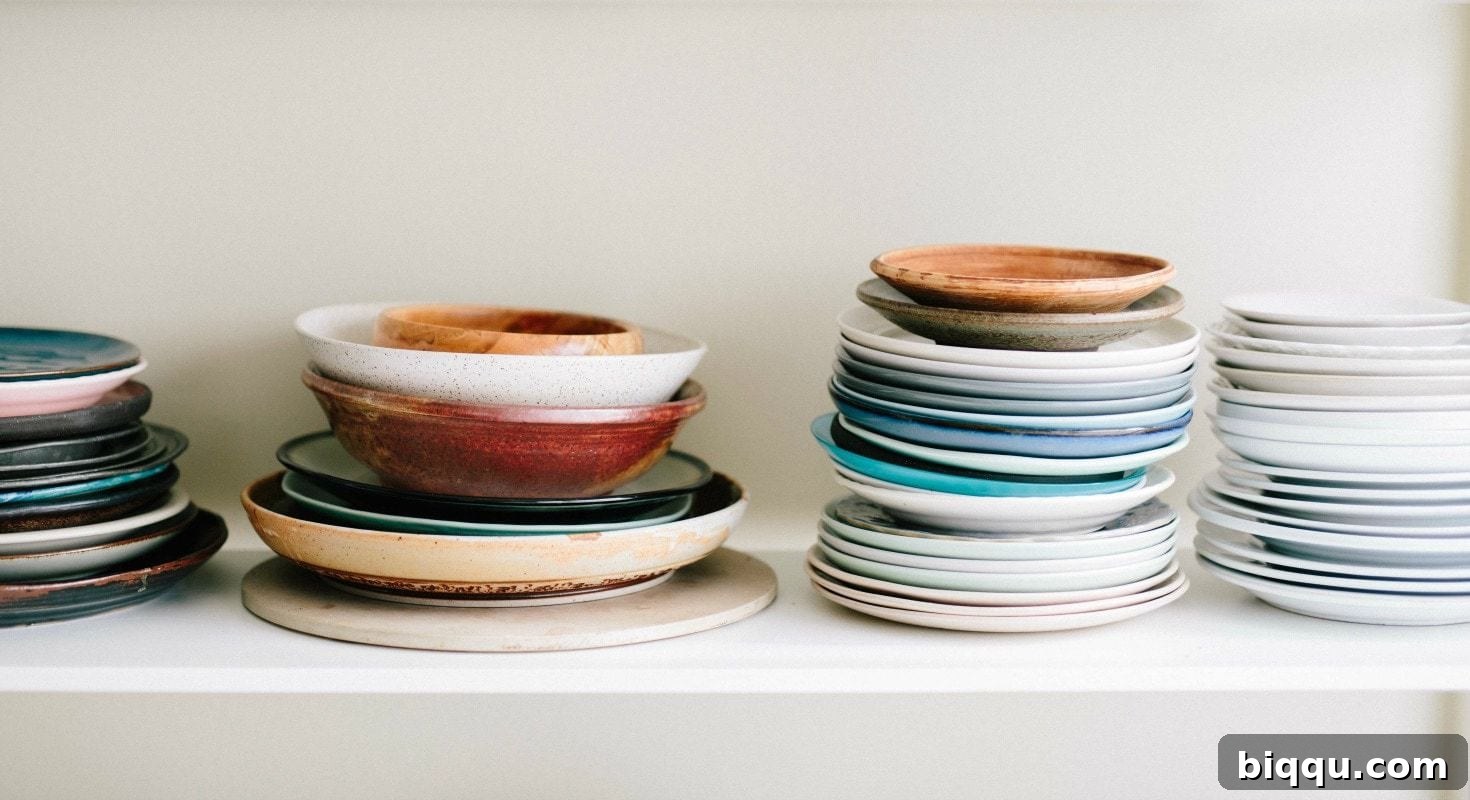
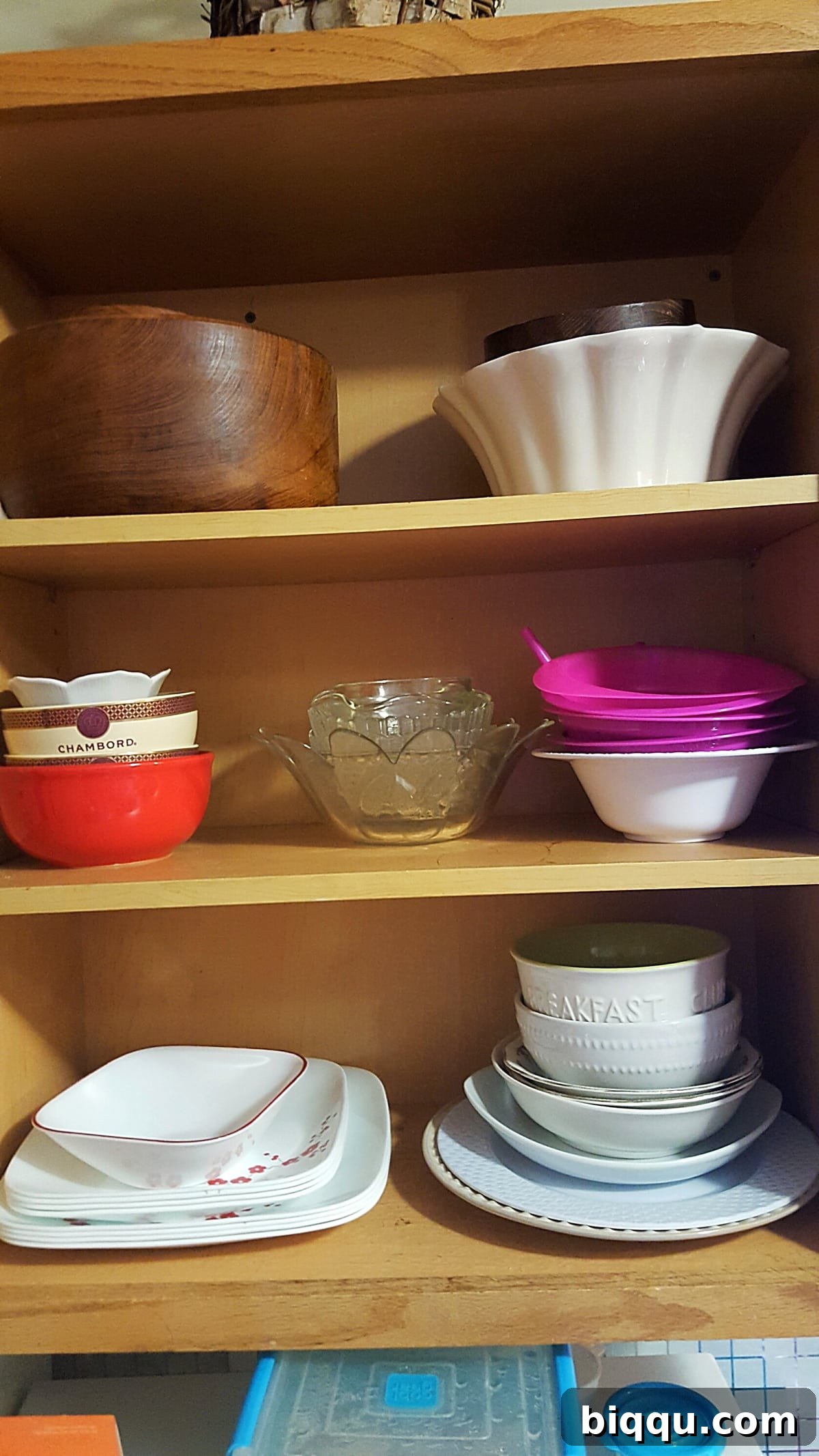
My plates cabinet was another area that desperately needed attention. It was SO challenging to get everything to fit, often involving a frustrating puzzle-like effort to stack items just right. The lesson here was undeniable: if there isn’t ample space for an item without forcing it, it’s a strong indicator that it might not belong in your home. I made the tough but necessary decision to significantly reduce my collection of plates. I kept one complete dinner matching set, perfect for everyday use and entertaining, along with a select few bowls. Many of these remaining bowls primarily serve as versatile props for my food photography, a functional purpose within my work. The transformation of this cabinet, once a source of daily frustration, is remarkable. Now, everything has its place, and the cabinet is effortlessly organized and accessible. This is what it looks like now, a picture of calm and order:
Beyond the smaller kitchenware, I also turned my attention to appliances that were consuming valuable counter and cabinet space without earning their keep. My coffee maker, for instance, became a prime candidate for relocation. My husband, Mr. N, once used it, and then it sat there for days, untouched, gathering dust. The truth is, neither of us are avid coffee drinkers; when the craving for coffee strikes, instant coffee perfectly satisfies the need, requiring no elaborate machine. This realization made it easy to part ways with the bulky appliance, immediately freeing up significant counter space and reducing visual clutter. Assessing the true utility of each appliance versus its perceived necessity is a crucial step in creating a truly minimalist and functional kitchen.
Once the boxes were full, my next step was clear: both boxes, brimming with perfectly usable items, would be taken to a local thrift store. Donating these items not only clears my space but also gives them a second life, allowing someone else to find joy and utility in them. This cycle of giving and receiving is a beautiful aspect of the decluttering process.
Throughout this intensive decluttering session, I also kept a couple of sturdy trash bags at hand. These were specifically for broken items, things beyond repair, or anything that was, quite frankly, just pure rubbish. It was astonishing how quickly these bags filled up, highlighting just how much true waste had been accumulating alongside the usable but unwanted items. Clearing out actual trash provided a different kind of satisfaction, a literal removal of junk from my living space.
This journey through my kitchen taught me invaluable lessons about possessions, space, and mindfulness. Here are some of the key takeaways I gathered from the process of decluttering:
- Decluttering Takes Time and Patience: This is perhaps the most crucial lesson. Forget the notion of a quick 20-minute fix. To truly declutter and organize a space like a kitchen effectively, it requires significant time and effort. It took me approximately three full days to meticulously go through all the cupboards, drawers, and surfaces in my kitchen, and I still have one final drawer that needs my attention. So, if you’re embarking on your own decluttering project, approach it with realistic expectations. Understand that it’s a marathon, not a sprint, and allow yourself the necessary time to do it thoroughly. The only exception might be if you already maintain a highly minimalist kitchen, in which case a quick purge is all you might need. High five, sister, if that’s you!
- Decluttering Goes Hand-in-Hand with Cleaning and Organizing: These three activities are deeply interconnected. As you empty cabinets and drawers, you’ll inevitably encounter dust, crumbs, and forgotten spills. This is the perfect opportunity for a deep clean – wiping down surfaces, washing shelf liners, and scrubbing away grime. Once cleaned, the re-organizing phase becomes much more intentional. With fewer items, you can create a more logical and accessible layout, ensuring everything has its designated spot and is easy to retrieve. It’s a holistic approach that results in a truly refreshed space.
- The Feeling of Decluttering is Immensely Gratifying: After the initial hard work, the emotional and mental payoff is extraordinary. Stepping back and looking at a clean, organized, and clutter-free kitchen is like taking a deep breath of fresh air. There’s a profound sense of calm, peace, and accomplishment that washes over you. The visual clutter that once contributed to mental stress is gone, replaced by an inviting and functional environment. This feeling alone is powerful motivation to continue the journey.
- Decluttering is Not an Endpoint, But a Continuous Practice: While the initial purge is transformative, the journey towards minimalism doesn’t end there. To truly maintain a clutter-free space, you must commit to a conscious shift in your consumption habits. This means actively choosing not to buy more things that are not absolute necessities. Without this ongoing commitment to mindful purchasing, you risk falling back into old habits, and your hard-earned decluttered space will inevitably become cluttered again. It’s about building sustainable habits for long-term simplicity.
Now, my kitchen holds only the items I truly use and absolutely need. But this is not the end of the story. In three months’ time, I plan to revisit every cupboard and drawer for a second, even more rigorous purge. This follow-up session will allow me to assess if any items I initially kept have remained unused, identifying any lingering ‘impurities’ – items that don’t genuinely serve my lifestyle. And you know what? This entire process has left me feeling incredibly light, both physically and mentally! The thought of moving house, whenever that exciting event occurs, no longer seems so daunting because there will be significantly fewer things to pack. That, my friends, is a definite win!
Beyond the physical act of doing away with material things I no longer need, this commitment to a more intentional lifestyle has also extended to making better, more conscious food choices. My kitchen transformation has become a catalyst for a healthier approach to eating. Here are some of the significant changes I’ve implemented:
- No More Purchasing Refined Sugar: This was a big one for me. I’ve completely transitioned away from buying refined sugar. While unrefined sugar might be three times the price, the health benefits far outweigh the cost difference. I prioritize my well-being, and this switch is a core part of that commitment. I now exclusively use unrefined sugar for all my baking and any other sweetening needs. Occasionally, for an extra boost of natural goodness, I opt for honey as a wholesome alternative. This simple change has had a profound impact on the quality of our meals.
- Prioritizing Organic, Whole Foods: If you reside in America, you’re likely aware that many products marketed as ‘food’ are often heavily processed and genetically modified, deviating significantly from their natural state. When I first moved here, I admit I purchased items blindly, without much thought. However, I’ve since educated myself and now meticulously check food labels. My rule of thumb is clear: if a product isn’t certified “organic,” it doesn’t make it into my shopping cart. This commitment led me to discover and regularly shop at Whole Foods Market, a fantastic resource where high-quality organic products are readily available. It’s an investment in my health and peace of mind.
- Embracing an Abundance of Fruits and Vegetables: This has become a non-negotiable part of my daily routine. I genuinely feel a sense of unease if a day passes without me consuming a generous amount of fruits and/or vegetables. To ensure this is always possible, I make it a priority to keep my kitchen stocked with a vibrant array of fresh produce. This way, I always have healthy options readily available for snacking throughout the day. Furthermore, I’ve rediscovered my love for making creative and delicious salads, transforming simple greens and vegetables into satisfying and nutritious meals.
And there you have it, folks! My kitchen is officially decluttered, organized, and filled with items that truly serve a purpose. The overwhelming feeling of lightness and improved well-being is palpable. I sincerely hope that my experience and insights can inspire you in some way on your own journey towards a more intentional and minimalist lifestyle. Should you be seeking additional kitchen organizing tips, I highly recommend checking out this post I wrote a while ago, which offers even more practical advice.
Up next on my minimalism adventure is my wardrobe. I absolutely cannot wait to cleanse it of all its ‘iniquities’ – that is, clothes I haven’t worn in ages and no longer truly need. So, mark your calendars and be sure to check back next Tuesday, January 31st, to read my full report on how I tackled that exciting challenge. For those eager to jump ahead, you can read the updated post on how I decluttered my wardrobe. Meanwhile, I’d love to hear from you! Do you have any fantastic kitchen maintenance tips you swear by? Or perhaps some thoughts on this post and your own decluttering experiences? Please feel free to share your insights in the comments section below. I’m always eager to connect and learn from your perspectives!