
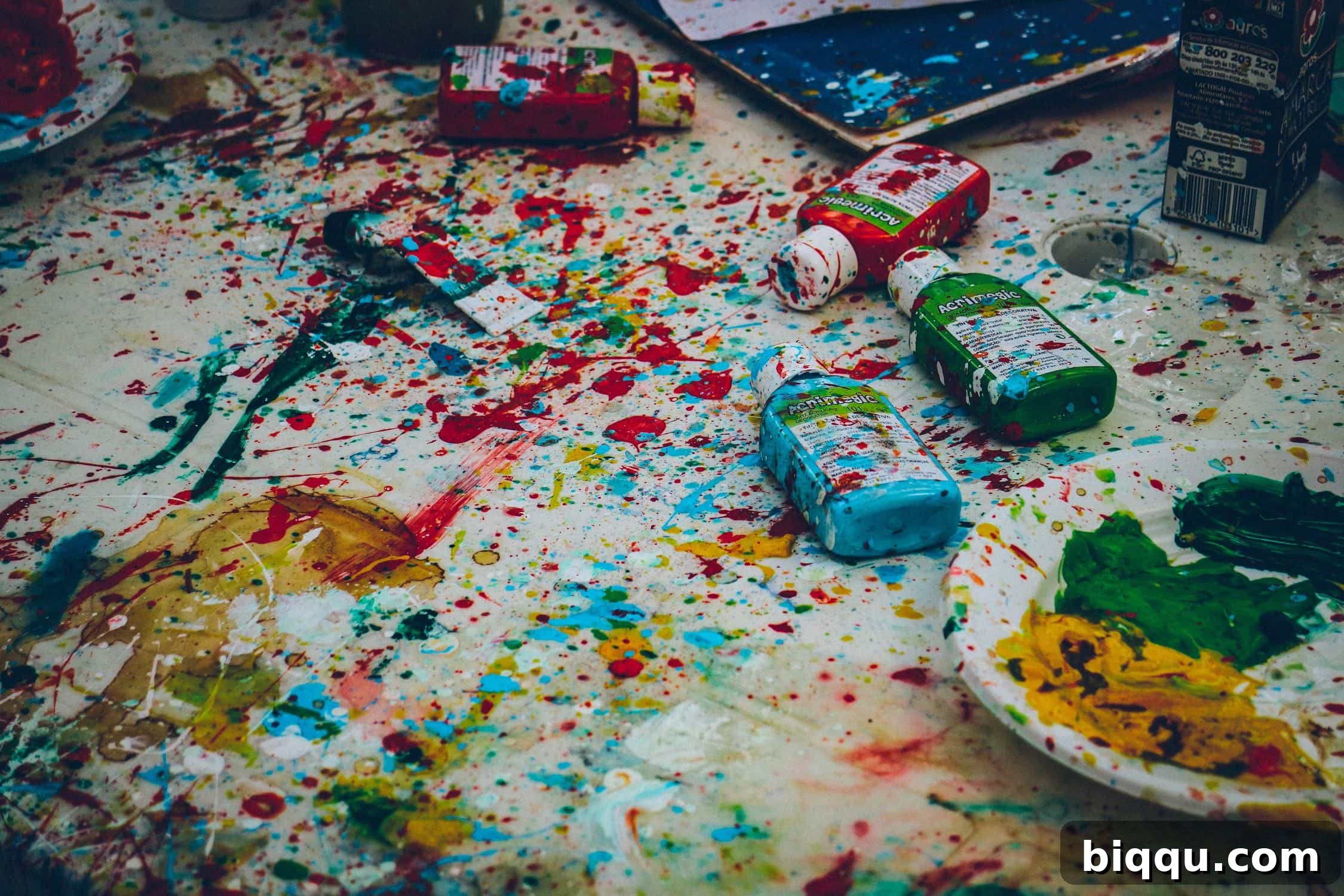
The mess. Oh, the relentless, ever-present mess! For many parents, these words evoke a deep, primal groan, a weariness that seeps into the bones. It’s an undeniable, often overwhelming, characteristic of family life, especially with young children. As I sit here, attempting to gather my thoughts, the evidence of its reign is splattered across my kitchen.
Just moments ago, a scene unfolded that epitomizes the beautiful, frustrating chaos of parenthood. My spirited three-year-old, with an insatiable curiosity and a budding chef’s ambition, decided to “cook.” Her culinary experiment involved pouring a generous amount of water into a pan of cooking oil I had left cooling on the stove. In a well-intentioned but ultimately ill-fated attempt to mitigate the damage, I placed the oil back on the heat, hoping the water would simply evaporate. Instead, I inadvertently orchestrated a spectacular, high-octane splatter-fest. Tiny droplets of oil, propelled by the boiling water, launched themselves across every conceivable surface – the cabinets, the walls, the floor, even finding their way into the most improbable nooks and crannies. The aftermath is a glossy, greasy testament to her exploratory spirit, a cleaning challenge that feels akin to defusing a small, oily bomb. I’ve tried to tackle it, but the sheer volume and widespread distribution demand an army of paper towels and a dose of industrial-strength cleaner, neither of which I currently possess.
This isn’t an isolated incident, merely a particularly vivid example of the domestic landscape I navigate daily. The living room floor, a minefield of forgotten toys, threatens to pierce unwary feet at every turn. Miniature cars, building blocks, and various plastic creatures lie in wait, ready to ambush unsuspecting parents. The kitchen table, a canvas for countless meals and craft projects, perpetually accumulates crumbs, sticky residues, and faint crayon marks, demanding endless wiping – a Sisyphean task that seems to repeat a thousand times a day.
Look around my home, and you’ll find an eclectic collection of “things that shouldn’t be there but somehow are”: a single sock, orphaned from its pair, curled beneath a sofa cushion; a scattering of tiny, unidentifiable particles; a rogue puzzle piece nestled beside a forgotten snack wrapper. These are the indelible fingerprints of childhood, the daily evidence that small, energetic humans inhabit this space. And then there’s the paper avalanche. Drawings of smiling suns, abstract squiggles, and fantastical creatures adorn every available surface – the fridge, the walls, even occasionally the furniture. My daughter, a self-proclaimed “budding artist,” approaches her craft with the dedication of a professional, transforming reams of paper into vibrant, albeit often discarded, masterpieces.
For far too long, my life felt undeniably defined, and often diminished, by this pervasive mess. A deep-seated frustration would bubble to the surface, accompanied by a chorus of exasperated questions: “Why can’t everything just be in its proper place? Why are there always dishes to wash? Why is there never a clear path to walk?” The yearning for order, for a pristine, magazine-worthy home, often clashed violently with the reality of raising energetic, curious children. I’d find myself growing angry, bitter even, at the constant disarray, wishing for a quiet, clean sanctuary that seemed perpetually out of reach.
Yet, amidst these feelings of overwhelm, a gentle whisper began to stir within my heart. It was a subtle, yet profound, shift in perspective, a quiet reminder that perhaps the mess isn’t merely an inconvenience, but an integral part of something far greater: growth. It’s a truth I’m still learning to fully embrace, but one that has begun to transform my relationship with the chaos that surrounds me. If I were to insist on a perpetually spotless, perfectly ordered environment, I would inadvertently stifle the very exploration and experimentation that are crucial for my children’s development.
Consider the kitchen. If I were to always cook alone, meticulously measuring and stirring, ensuring not a single crumb or drop went astray, my children would never learn the joy and skill of culinary creation. But when they “assist” – which often involves spilled flour, rogue eggshells, and ingredients finding their way onto the floor rather than into the bowl – the kitchen undeniably becomes a disaster zone. Pots clatter, utensils scatter, and the counter surfaces transform into a sticky, flour-dusted tableau. The cleanup is invariably more extensive than if I had simply tackled the task solo. However, in that chaotic process, they are learning invaluable lessons: about measurements, textures, following instructions, and the simple satisfaction of creating something with their own hands. They are building confidence and practical life skills, one messy experiment at a time.
The same principle applies to household chores. How will they ever learn to wash dishes if they aren’t given the opportunity to try? Their early attempts are, predictably, a symphony of splashing water, overflowing suds, and wet countertops. Soap bubbles drift onto the floor, water cascades down cabinet fronts, and a surprising amount of cutlery remains stubbornly greasy. It’s certainly messier than if I were to do it myself, far from the efficient, pristine operation I might envision. But each splash, each misplaced bubble, is a step in their learning journey. They’re developing fine motor skills, understanding sequence, and slowly, surely, grasping the concept of responsibility and contribution to the family unit. The mess, in these instances, isn’t a byproduct to be avoided, but a necessary component of their education.
Beyond the practical skills, the mess also fuels their imaginative and creative development. The scattered art supplies, the glitter trails, the smudges of paint – these are the remnants of vibrant inner worlds brought to life. When they are given the freedom to draw, paint, build, or invent without strict parameters, they are developing problem-solving skills, fostering creativity, and expressing their unique personalities. A living room transformed into a fort, a bedroom strewn with dress-up clothes, a floor covered in LEGO bricks – these are not just messes; they are landscapes of play, theaters of imagination, and workshops of budding innovation. These are the environments where minds are stretched and creativity takes flight, leaving behind a delightful trail of chaos.
And let’s not forget the major milestones. Potty training, for instance, is inherently messy. There will be accidents – many of them – before that little human masters the intricacies of using the toilet. Learning to eat independently means food on the face, the high chair, and the floor. Learning to dress oneself might result in mismatched socks and backward shirts, but also a growing sense of autonomy. These aren’t failures; they are the unavoidable, often humorous, steps on the path to independence. Each spill, each misplaced item, each “oopsie” moment is a teaching opportunity, a chance to learn cause and effect, to practice fine motor control, and to develop resilience in the face of minor setbacks. The mess, therefore, becomes not just tolerated, but embraced as an essential tool for their holistic growth.
So, I am learning to embrace the mess, not as an adversary, but as a necessary, transient companion on this parenting journey. It is a fundamental aspect of life with children, a tangible representation of their active engagement with the world. Times of profound growth are almost invariably times of inherent messiness. We cannot expect perfectly clean developmental stages, just as we cannot expect a seed to sprout without disturbing the soil. In all these seemingly chaotic moments, I find immense solace. I see not just scattered toys or spilled milk, but undeniable proof that little people are actively learning, exploring, and growing. My children are being transformed every single day, developing new skills and understanding the world, one messy endeavor at a time.
While I certainly hope they will grow into neat and organized individuals, I understand that, for now, accidents and mistakes are part of their learning curve. They will make spills before they learn to handle cups carefully. They will create chaos before they fully grasp the art of tidying up. These are not flaws but foundational steps. Expecting a life utterly free of mess with children is akin to expecting the sun not to set; it’s an unrealistic fantasy that only leads to frustration and disappointment. Parenthood, in its purest form, is often a journey through beautiful chaos, a constant negotiation between order and active living.
I still occasionally feel that familiar surge of anger or bitterness when confronted with a particularly daunting mess. It’s a natural human reaction to disorder. However, I am consciously practicing a new mantra: “This is necessary. This is growth.” Being angry or constantly striving for an unattainable level of perfection only detracts from the joy of parenting and the connection with my children. As their mama, my primary role isn’t to prevent all messes, but to facilitate their learning through exploration, offer gentle guidance, and, yes, often clean up after them. It’s a labor of love, a tangible way of supporting their journey towards competence and independence.
For all the mothers, fathers, and caregivers out there navigating similar seas of glorious disarray, remember this: we must learn to embrace the mess and find sustainable ways to work around it. We must find solace in the profound truth that the mess isn’t a problem to be eradicated, but an essential component of our children’s development. It is a sign of life, of learning, of growing, of childhood itself. It’s temporary, yet utterly vital.
What are the most challenging or “crazy-making” messy situations you encounter in your home? And, on a more practical note, any ingenious tips or tried-and-true methods for effectively cleaning a substantial amount of oil off kitchen cabinets, the floor, the stove, and those elusive, tiny crevices?
P.S. I originally penned a version of this post two years ago. The enduring relevance of its message continues to resonate deeply today!